Taa-laa-wa Dee-ni’ Dan’-waa-ghii~-li~
“The Tolowa Dee-ni’ History”
“The Tolowa Dee-ni’ History”
The Taa-laa-waa-dvn
A. Dee-ni’ | Xvsh
The aboriginal lands of the Tolowa Dee-ni’, the Taa-laa-waa-dvn, lay along the Pacific coast between Wilson Creek to the south, Sixes River to the north and inland to the Applegate River. The pre-contact Dee-ni’ population exceeded ten thousand. The Dee-ni’ emerged at Yan’-daa-k’vt, the Center of the World, our place of Genesis. Our language is a member of the Dené Language family, which shares a common ancestral language. The Dené Language family was formerly known as the Athabaskan Language family. The original names for ourselves are the Dee-ni’ or the Xvsh. Other names include the Chit-xu (Chetco) and the T’uu-du’-dee-ni’ (Tututni). The Taa-laa-wa Dee-ni’ were first referred to as the Tolowa by Stephen Powers in 1862. The name Tolowa is an Algonquian word from the Yurok and Wiyot tribes for the village of Yan’-daa-k’vt. It was the largest population center of the Taa-laa-wa.
The name Dee-ni’ means to be a citizen or a person from a yvtlh-‘i~. The name dee-ni’ was composed by adding the word ending –dvn, meaning place or at and the possession suffix -‘i’. The suffix -‘i’ means “to belong to continually.” For example, the word Taa-‘at Dee-ni’ means a citizen of Crescent City. It was created from the word Taa-‘at-dvn meaning: at Crescent City. The meaning of Taa-laa-wa Dee-ni’ is be a Tolowa citizen.
The word Xvsh means human being. Before the Whiteman invaded, we and our neighboring tribes were the Xvsh or human. After the Whiteman arrived the word Xvsh took on the additional meaning as we the Indian and human being. For example, the Yurok are known as the Dvtlh-mvsh Xee-she’, the Yurok humans. The Karuk are known as the Ch’vm-ne Xee-she’, the Karuk humans.
The Dee-ni’ names Chit (or Chit-xu) and the T’uu-du’-dee-ni’ were borrowed into the English language as the names Chetco and Tututni (Too-toot-nee) Dee-ni’.
B. Yvtlh-‘i~ | Territory
The Taa-laa-waa-dvn provided a vast and varied source of foods and resources for the Dee-ni’. The rivers were densely populated with several species of salmon, steelhead and trout. The sea provided multiple sources of protein from clams to whale and sea lion meat. The lake and lagoon provided a multitude of duck and geese. The land was filled with nuts, berries and game. The herds of deer and elk ran in the hundreds. A high variety of plants and herbs both fed and healed the Dee-ni’. The immense redwoods provided both river, lagoon and sea going canoes.
The Taa-laa-waa-dvn was divided into eleven yvtlh-‘i~ or governance polities. The yvtlh-‘i~ was a specific section of land owned and governed by the headmen and citizens living there. Each yvtlh-‘i~ included land for food, prayer and general resources for making a living, as well as a section of the coast, an expanse of river and an inter-mountain access. The interior upper Rogue and Illinois Valley yvtlh-‘i~ traded with the coastal yvtlh-‘i~ for coastal resources.
Each yvtlh-‘i~ developed its own dialect of the Dee-ni’ language. A dialect language is a member of the same language that has developed small changes from each other that are yet fully understood by one another. It was known immediately upon speaking with each other where that speaker was from.
Also, in addition to Dee-ni’ dialects is the difference between speech registers. A speech register divides the language-use communities from one another by the vocabulary and the correct and efficient use of the grammar. The Dee-ni’ language had a lower and higher speech language register. The high register speakers were instructed in the proper or full use of the language vocabulary and the grammar. The lower register speakers spoke a more simplified vocabulary and used a more simple grammar. The language used polite and less polite colloquialisms to refer to socially awkward subject matter.
Tr’vt | Money
The dentalia shell currency or tr’vt formed the basis of the Dee-ni’ economy. Tr’vt moved south to the Taa-laa-waa-dvn from British Columbia. A wealthy man might own one strand of ten carved or decorated two-inch tr’vt. All tr’vt measuring less than two inches were considered highly valued beads. A single shell long enough to cross the palm of a man’s clinched fist paid for a death in a settlement case. Tr’vt was exchanged here and then went east to the Karuk and then down the Klamath River to the Yurok and Hupa people.
The towns centered around the Headmen or Xvsh-xay-yu’. Each house was fashioned from planks and had a stone paved porch. The large houses belonged to the Xvsh-xay-yu’. The homes of the Xvsh-xay-yu’ were named denoting something special about its character. The Xvsh-xay-yu’ governed over his townsmen and all official governmental duties. He enforced the law through the Bosses or Mii~-xvsh-xay. The Mii~-xvsh-xay were well trained in combat and warfare.
Naa-yvlh-sri Nee-dash | World Renewal Ceremony
Each Winter Solstice the Dee-ni’ made the annual pilgrimage to Yan’-daa-k’vt for the high Naa-yvlh-sri Nee-dash Ceremony. The Naa-yvlh-sri is the World Renewal Ceremony for the recreation of the universe and all who live upon and within it. Additional Nee-dash Ceremonies were held to commemorate an event or to celebrate a loved one from harm or illness.
Waa Ghvtlh-xat | The Way They Lived
The daily life of the Dee-ni’ was to rise before sunrise to bathe and pray. The morning chores were completed and then they had the first meal of the day. At noon the Dee-ni’ prayed once again. The dinner meal was eaten and then the evening prayer was offered before bed. At dusk the Dee-ni’ settled in for the night. The only individuals who trounced around at night were the Det-naa-ghi, the Night Walkers. The Det-naa-ghi were practitioners of the Dark Arts. They could kill others with their powers and formulas. The oppositional forces to the Det-naa-ghi were the Dii-nvn, or Shamans. They were the practitioners of defense and healing. At times, the Dii-nvn and Det-naa-ghi were in conflict against one another over a person made ill and the healing of that person.
Ghii Natlh-mii~-t’i Daa-nvtlh-xat | “The European Invasion”
The survival of the Dee-ni’, our language and religion has endured the fire storm of European contact, obliteration and subjugation. Initially in the 1700s, scattered trading visits with the Spanish and Russians aboard their clipper ships brought the Dee-ni’ in contact with new metals and glass beads. Jedidiah Smith made a passing visit through the Dee-ni’ homelands in 1828. Additional contacts with the men of the Hudson Bay Company occurred from 1838-39.
Starting in 1850 the mass invasion of immigrants came to the Taa-laa-waa-dvn, the Dee-ni’ homeland, following the California Gold Rush of 1849. The initial years of European colonization across the Pacific Rim resulted in numerous mass annihilations of Indians. Millions were exterminated by military massacres and immigrant dragoon squad campaigns, wherein thousands of the Dee-ni’ were massacred and imprisoned. The indiscriminate burning and near complete blood bath devastation of their population centers and suburbs lay to waste ninety-five percent of their population. The entire coast from Sixes River to Wilson Creek throughout this period at one point or another had been set ablaze.
This devastation forged the new Dee-ni’ word Natlh-mii~-t’i, meaning Whiteman. Natlh-mi~ is a knife or sword and –t’i means: restricted-as, -by, or -to. Natlh-mii~-t’i describes the immigrant as: “The-One-of-the-Knife or –Sword,” the “Knife Brandisher.” The genocide of the Dee-ni’ during the Tolowa Dee-ni’ Holocaust began in 1853 and ended in 1856, but their subjugation, murders and repression has persisted through to the 21st Century.
During the year of 1853, Xaa-wan’-k’wvt at the mouth of Smith’s River (today call Smith River) was attacked, wherein 70 Dee-ni’ perished. Some survivors were imprisoned in the military concentration camp at Wilson Creek. Others relocated to Srdvn-das-‘a~, The Island, a Xaa-wan’-k’wvt suburb. During that spring, Taa-‘at-dvn at Crescent City was burned and the survivors were removed to Yan’-daa-k’vt. Following that removal, Yan’-daa-k’vt was attacked with hundreds of Dee-ni’ being ruthlessly slaughtered during the Naa-yvlh-sri Nee-dash, Earth Renewal Ceremony.
In 1854, the attacks continued with the burning of Chit in Brookings by Mr. Miller. In December of 1854, White rumors escalated about the presence of Rogue River, Chetco and Klamath Indians at a local Rancheria in Smith’s River Valley. The Indians were there gathered in making preparations for the annual Naa-yvlh-sri Nee-dash. This Naa-yvlh-sri Nee-dash was being held at ‘Ee-chuu-le’ because Yan’-daa-k’vt, the place of Genesis, had been obliterated. On January 1, 1855, the Coast and Klamath Rangers along with the settlers of Smith’s River Valley descended on the Dee-ni’ gathered for Nee-dash at ‘Ee-chuu-le’ on Lake Earl. The results of this massacre left seven layers of bodies in the Dance House before it was set on fire. One Bill Saville, who came from London, England, brought with him his double barreled rifle. Saville boasted that he himself had killed more Indians than anyone else in the party, for the others had only single shot guns. He described the Dee-ni’ as “Smoked Yankees.” He later became one of the first Del Norte County supervisors from 1857-63 and served as district attorney from 1867-81. In the years to follow, the Naa-yvlh-sri Nee-dash continued on Srdvn-das-‘a~, The Island, hosted in the last remaining Dance House that had belonged to Headman K’ay-lish.
Following the ‘Ee-chuu-le’ massacre, a treaty was negotiated at Xaa-wan’-k’wvt from January 2-4, 1855, between the Dee-ni’ representatives: K’ay-lish, K’us-t’uu-t’i and Yu’-xaa-svlh, and the White representatives: A.K. Hamilton as Chairman and J.S. Wallace as the Secretary. The treaty brought a short lived peace on the Smith’s River. The Rogue River and Klamath River Indian wars broke out in 1855 and resulted in the creation of the Coast (Siletz/Grand Ronde) Reservation located to the far north in the Oregon Territory and another, The Klamath River Reservation, on November 16, 1855. In 1856, the holocaust continued from Natlh-tee-nee-dvn (Lone Ranch) to Ts’aa-xwii-chit or K’wvt-t’uu-mvn on the Sixes River. At Hunter Creek the doors of the plank houses were blocked shut and the inhabitants who were trapped inside burned to death. All of the houses in the Smith’s River Valley were set ablaze. On the shirt tails of the Xaa-wan’-k’wvt Treaty, three brothers arrived at Xaa-wan’-k’wvt from the ruins of Natlh-tee-nee-dvn. The Rangers chased them in hot pursuit. In a horrifying tragedy, the Headmen were forced to finally sacrifice the brothers to prevent the remainder of the Dee-ni’ from being slaughtered. With the murder of the three brothers, the U.S. government agreed to pay the Dee-ni’ for the burning of their villages, the taking of their lands and what they had done to their country. They went on to say that the Dee-ni’ would never be molested again and could go out and stay where they wanted. Then the Dee-ni’ were able to live unbothered on Srdvn-das-‘a~, The Island. With the death of the three “Renegades” at Xaa-wan’-k’wvt, with the last of the Dee-ni’ removed from the Pistol and Chetco Rivers and remanded to the Coast Reservation, at last, the Rogue River Indian war ended on July 9, 1856.
As the initial Holocaust was ending in 1856, the Ethnic Cleansing of Indians continued throughout the western United States. All Indians from the Winchuck River to the Tillamook Bay were forcibly removed to the Coast Reservation at Siletz, Oregon. The only exceptions allowed to stay behind were for those women who were married to Whitemen. Anyone else who was attempting to stay behind was executed. The U.S. Government removed 1,834 Dee-ni’ to the concentration camps at the Coast Reservation from 1856-58, with some Dee-ni’ taken as far away as the Warm Springs and Umatilla Reservations in eastern Oregon. The several hundred Dee-ni’ imprisoned at Wilson Creek were removed to Fort Terwer on the Klamath Reservation in 1857. Many Dee-ni’ refused to remain imprisoned there and continually escaped to return home. More Dee-ni’ casualties resulted from the arrival of European diseases that resulted in catastrophic epidemics during the 1860s.
Concurrently, the State of California Indian Child Slavery Law and the State practice paying for Dee-ni’ scalps was in effect. In 1855 Indian slaves brought in $50 to $250 each. It was legal to murder the Indian parents and sequester their children for sale into slavery as orphans.
Na’sr-ghinlh-chut-dvn | The Reservation
As a result of the Xaa-wan’-k’wvt Treaty, and the destruction of Fort Terwer by the 1861 flood on the Klamath, the 17,000 acre Smith’s River Reservation was established on May 3, 1862.
An Executive Order was given to create the Hoopa Valley Reservation on April 8, 1864. That order lead to the annulment of the Smith’s River Reservation on July 27, 1868 and the relocation of the Indians held there. The Dee-ni’ were once again imprisoned, this time at Camp Gaston on the Hoopa Valley Reservation in 1870. They again continued to escape to their “former haunts” in Del Norte and Curry counties.
In a shocking event, the Wiyot and Wailaki from Humboldt Bay and the Eel River, which were being held at the Smith’s River Reservation, were executed by the orders of the officers rather than being relocated to the newly formed reservation. Their remains were interred in a mass grave on the Smith’s River Reservation. The lands of the Smith’s River Reservation were opened up to White squatters. Of the original several thousands of the Dee-ni’ population only a few hundred souls survived. A residual Dee-ni’ population managed to disappear and hold on to life in the Taa-laa-waa-dvn.
The Ghost Dance was introduced from Siletz in 1872. The Dee-ni’ embraced the new religion and danced upon the floors among the ruins of the once great towns of their people. Several Dee-ni’ became dreamers and helped to release the spirits of the thousands of holocaust victims to cross the water and find peace with the Yaa-me’ Dee-ni’, “The Sky People.”
A. ‘Ee Wa’sr-nii~-‘a~ | Allotments
During the 1890s a few individual Dee-ni’ living in the homeland received Individual Federal Trust Allotments. Most of these allotments were located in remote uninhabitable locations. The last remaining allotment of that era is the Jane Hostotlas Allotment at Nii~-lii~-chvn-dvn, the Fish Dam place along the Smith River.
B. Si’s Ch’a’sr-nii~-t’as-dvn | Scalping Period
The documentation of Indian scalping for a bounty persisted at least until 1895 in Del Norte and Siskiyou Counties. The California Indian population plummeted from millions to 15,000 by 1900. In 1902, the last pre-contact Dee-ni’ who lived at the Xaa-yuu-chit, “Hiouchi,” village along the Smith River was murdered. Mr. Sawyer noted that a Mr. Zofti lived near the site. Zofti told him that the last Indian (a renegade) lived on the site around 1902. He was chased into the forest and shot by local white residents.
The Dee-ni’ imprisoned at the concentration camps on the reservations on both the Hoopa Valley Reservation in California and Coast Reservation in Oregon were remanded to suffer there until the Imprisonment Ban was lifted in 1902.
Srdvn-das-‘a~ Ch’aa-nin-lat | The Island Washes Away
Srdvn-das-‘a~ began to erode into the Smith’s River in 1903. In 1906, 113 Dee-ni’ were counted in Del Norte County with small residual populations to the north. Federal appropriations, under the Landless California Indians Act of 1906, established two Tolowa Dee-ni’ Rancherias at Smith River and Elk Valley. The dead were exhumed from Srdvn-das-‘a~ and reinterred at the old Tr’in-des-‘a~ Cemetery located within the Smith River Rancheria in 1908. The “new” cemetery was named the “How-on-quet” Cemetery. The winter solstice Naa-yvlh-sri of 1910 was the last time the ceremony was to be held on Srdvn-das-‘a~. Naa-yvlh-sri moved to the Smith River Rancheria for the continued solstice ceremonies.
Daa-wii-laa-ne | Population
The 1910 census counted 121 Dee-ni’ in California and 383 Dee-ni’ in Oregon. Hundreds of Dee-ni’ descendants remained on the reservations to become part of those confederated tribes at Hoopa and Siletz. The Dee-ni’ began to renew life and settle into a new era of their ancient human history. The formation of a new Tribal Governments and Community Associations strengthened their journey forward.
Me’-aa-wvtlh-ts’it-dvn | Schooling Period
Federal interruption and subjugation continued through the policies and practices of the Bureau of Indian Affairs (B.I.A.). Beginning in the 1890s, the B.I.A. forced Dee-ni’ children to attend boarding schools by confiscating them from their parents and families. The boarding schools at Chemawa in Oregon, Stewart Indian School in Nevada and the Sherman Institute in Riverside, California were tools of de-culturalization where “Kill the Indian, Save the Man” was the operational philosophy. Children were brutalized for being and speaking Dee-ni’. This story describes a true life experience of a young Dee-ni’ girl in the 1920s:
Laura Scott was born at Nii~-lii~-chvn-dvn in 1908. She was seized by the B.I.A. at the age of 12 and sent to the Sherman Institute. She was caught speaking Dee-ni’ while at Sherman. She was punished by being forced to peel a 500-pound bin of onions. Due to the pungent stench, by the end of her punishment, her snot hung in her lap and she could no longer see. She could only feel the onions with her hands and the knife to finish the chastisement. In complete desperation, she and four girls planned their escape from the institution. Each of the girls was from a different reservation located across the state. Laura’s home was the most distant one away, located at the opposite end of the state.
For several days, the girls snuck the counted and guarded food rations from the commissary, cut the screen and slid down knotted sheets to freedom into the night. They traveled at night and hid during the day to hide from the Federal Agents who pursued them. Arriving at each girl’s reservation, they were cared for, recuperated and then the rest walked on north. Finally one year later, Laura and a Pomo girl reached Ukiah, California. She stayed there and managed to contact her mother, Alice. Alice hired a car and rescued her. Finally, Laura was once again home and safe in the deep, virgin redwood forests at Nii~-lii~-chvn-dvn on the Smith’s River.
Waa-tr’vslh-‘a~ K’ee Tr’vslh-chut-dvn | Religion Away Taken Period
The Bureau of Indian Affairs (BIA) imposed a Religion Prohibition with the Dee-ni’ religious freedoms abolished in 1923. The ten-night Naa-yvlh-sri Nee-dash Ceremony was broken up by federal agents. The Dance Makers were arrested, and the dance regalia was confiscated and later sold. Nee-dash went underground. The Naa-yvlh-sri Nee-dash was altered in order to survive.
The Dee-ni’ would gather and dance until it was ended at midnight and the regalia were hidden away. The rest of the night was finished up with the jig, the Jew’s harp and the drunken loggers. Following the Religion Prohibition, new religions arrived. The Methodist, Catholic and Four Square churches recruited Dee-ni’ membership. In 1928, the Dee-ni’ relatives from Siletz brought the Indian/Christian Shaker religion of 1881. Many Dee-ni’ joined The Shake to enjoy the protected status of that religion.
‘Aa-melh-k’vn-ne | Americanization (Acculturation)
Following the participation of the enlistment of Indians in World War I (WWI), American Indians became citizens of the United States in 1924. To no avail, the Dee-ni’ subjugation continued. In 1953, the U.S. Government imposed Public Law 280 (PL 280), which handed over to state control of many federal jurisdictions belonging to the Dee-ni’. PL 280 restricted Dee-ni’ legal jurisdiction over their own lands and crimes, and made their hunting and fishing for subsistence illegal.
K’ap-mvn’ Tr’vslh-tr’int-dvn | Government Termination
By 1960, with the exception of the village of Nii~-lii~-chvn-dvn at the Jane Hostotlas Allotment, the Dee-ni’ at Smith River, Elk Valley and Siletz had undergone Termination as federally acknowledged, aboriginal indigenous nations by the federal government. As a prerequisite to Termination, the BIA called for the formation of the Howonquet Community Association at Smith River to manage residual community parcels of land left in the wake of Termination. This event caused a re-scattering of the Dee-ni’ population and a loss of belongingness to their Mother Land. Termination caused serious attrition of traditional life ways, beliefs, the language and a breaking down of the family unit. Many Dee-ni’ held fast to their community association of 1929.
Dan’-taa-dvn Dee-ni’ Lheslh-xat | The Del Norte Indian Welfare Association
The Dee-ni’ had incorporated Del Norte Indian Welfare Association (DNIWA) as a non-profit organization in 1929. DNIWA served as the Dee-ni’ governance structure. Social advocacy, culture and language were the enduring focus of the association. During the 1950s and 1960s, the association sponsored the creation of California Indian Day; the re-emergence of the Nee-dash ceremony; and an initial writing of the Dee-ni’ language with the English alphabet. The English language and alphabet lacked several sounds needed to write Dee-ni’, so it was abandoned.
Dee-ni’ Wee-ya’ Lhee-na’sr-dvtlh-nvsh | Dee-ni’ Language Program
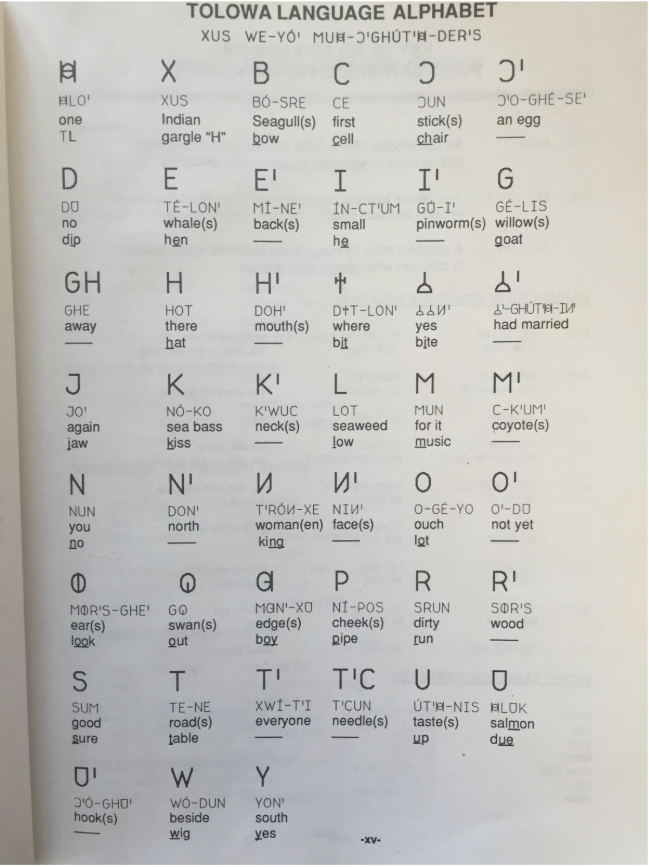
The Association sponsored the formation of the Tolowa Dee-ni’ Language program in 1969. The Dee-ni’ community began to write their oral tradition in earnest using the Tolowa version of the Uni-fon alphabet. The characters of the Uni-fon are unique and written down by hand. The historic use of the handwritten Uni-fon alphabet documented and amassed a good working foundation of linguistic information. Eventually, the DNIWA collapsed in 1972. It left behind an established Tolowa language program with two State Eminence Credentialed Tolowa teachers including a young tribal member pursuing a bi-lingual Teaching Credential at Humboldt State University. This effort created the first edition of The Tolowa Language book in 1983 and its second edition as the XUS WE-YO’ in 1985.
Ghii Nii~-lii~-chvn-dvn Lhetlh-xat | The Nii~-lii~-chvn-dvn Council
The Nelechundun Business Council had formed in 1973 to re-build the Nee-dash Ceremony and to confront Termination. The business council efforts resulted in the return of Nee-dash; as an open ceremony at Nii~-lii~-chvn-dvn in 1976 and in acquiring a successful grant from the Administration of Native Americans (ANA) for the Tolowa Status Clarification Project in 1982. The project developed a Tolowa Nation concept and filed a petition for federal acknowledgement with the Department of Interior (DOI) in 1983. Concurrently in 1983, the reversing of Termination was fulfilled by the Tillie Hardwick Case under the Indian Termination Policy.
K’ap-mvn’ Nuu-naa-tr’ulh-ts’it | Federal Acknowledgement
The Tillie Hardwick decision of 1983 restored the Tolowa and the U.S. Government Trust relationship. The renewed federal acknowledgement of the Tolowa Dee-ni’ absolved the need for the Nelechundun Business Council to proceed with the Tolowa Nation federal acknowledgement effort. The Nelechundun Business Council evolved into the Tolowa Nee-dash Society in 1997 and continues to support traditional Dee-ni’ religious practices.
The Trust restoration called for the dissolution of the Howonquet Community Association and also allowed for a devastating and capricious division of the Dee-ni’ by the establishment of two separate governments: one at the Elk Valley Rancheria and a second at the Smith River Rancheria (Tolowa Dee-ni’ Nation). The constitution of Howonquet Indian Council of the Smith River Rancheria affords the inclusion of all the Tolowa Dee-ni’ to participate in the Federal-Indian Trust relationship as a sovereign nation. Their membership has enjoyed the renewed sense of re-centeredness brought by the coupling together of the restored lands at the Smith River Rancheria and the trust lands of the Jane Hostotlas Allotment at Nii~-lii~-chvn-dvn.
These renewed forums of restoration allow the Dee-ni’ to continue the work of social development, cultural and linguistic regeneration, and tribal development that was left wounded by Termination. The survival of the Tolowa Dee-ni’ language and their religion remains a miracle.
Wee-ya’ Ch’v-ghvtlh-t’e’sr | Language Documents
During the Twentieth Century, a few anthropologists and linguists wrote Dee-ni’ words using their own alphabets and special characters. A story collection was done by Pliny Goddard in 1903. Edward Curtis photographed and published a short ethnography on the Taa-laa-wa Dee-ni’ in 1923. The Tolowa and Their Southwest Oregon Kin ethnography was completed by Phillip Drucker in 1937. It was followed by a single study of the Tolowa phonology by Jane O’Bright during the 1950s. These works, for the most part, were hand-written and limited to university use and their publications. These studies made no contribution to the efforts of the Dee-ni’ language community.
The Taa-laa-wa Dee-ni’ Wee-ya’ | Written Tolowa Language
The first writing of language started in the 1950s. The Taa-laa-wa attempted to write Dee-ni’ with the English alphabet. In the beginning, fluent speakers could read the written language because they were speakers. The following generations with limited speaking ability mispronounced Dee-ni’. The English alphabet sounds do not have the sounds needed to write Dee-ni’. Then the Times-Standard newspaper featured an article about the Hupa writing their language with the Uni-fon alphabet. The Dee-ni’ knew if Hupa could be written then so could Dee-ni’ because they are related languages.
Eunice Xash-wee-tes-na Bommelyn contacted Tom Parsons, the Director for the Center at Humboldt State University, to inquire about the Uni-fon alphabet for writing Dee-ni’. Tom began coming to Del Norte High School and started writing Dee-ni’ from the elders in 1969. The key elders were Amelia Brown, Sam Lopez, Ed Richards Jr., and Ella Norris. At this time all writing was done by hand. Betty Green was the official scribe.
During the 1970s, a typing element was designed for the Uni-fon letters to be used on a selectric typewriter. The first publication, The Tolowa Language, was printed in 1983. Loren Me’-lash-ne Bommelyn and Berneice Nan-ts’vn-numlh-k’vs Humphrey printed the next edition XUS WE-YO’ in 1989.
Lha’-ts’a’ Mvlh-tr’ee-t’esh
Uni-fon Alphabet
A. Ghii Mvlh-dvt-svn-dvn | The Computer Era
As the computer age developed in the 1980s, nothing was available for Uni-fon writing. The MacIntosh Computer Company developed special Uni-fon programs and installed it in a limited set of Apple computers. The Uni-fon alphabet has 20 consonants, 6 vowels, 1 reduced vowel and 3 diphthongs. Nine of the Uni-fon letters were not available on a keyboard. With these developments and limitations, a new Dee-ni’ alphabet needed to be “keyboard friendly.” In 1993, the Language Committee decided to replace the Uni-fon alphabet and shift to the Practical Alphabet.
The Practical Alphabet
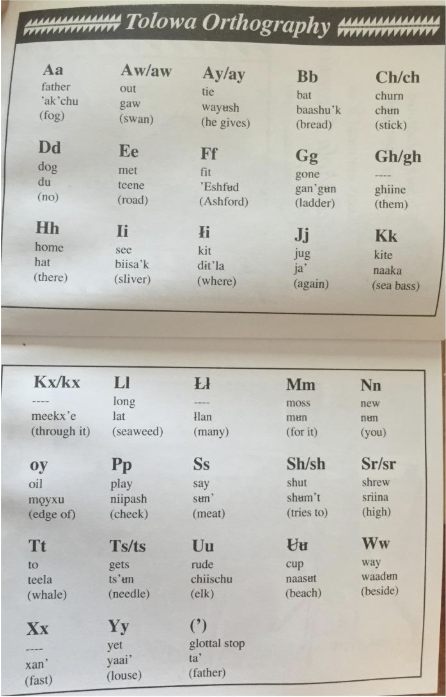
The Practical Alphabet has 24 consonants, 5 vowels, 1 reduced vowel and 3 diphthongs. The new typing needs were the barred-L, the barred-I, the barred-U and the nasal-hook. It was understood that these letters were available on computers, but they also required specialized computer programming and eliminated typewriter use entirely. The Language Committee managed to get the pocketbook, Now You’re Speaking—Tolowa: The Dee-ni’ People, Their Language, published in 1995.
In 1995, a phonemic sound study was completed by Loren Me’-lash-ne Bommelyn in conjunction with the Linguistics Department at the University of Oregon. The study isolated the sounds of Dee-ni’. This prompted the revision of the Practical Alphabet and resulted in the development of the Taa-laa-wa Dee-ni’ Mvlh-tr’ee-t’esh, the Tolowa Dee-ni’ alphabet, in 1997.
| Taa-laa-wa Dee-ni’ Mvlh-tr’ee-t’esh | |||||
|---|---|---|---|---|---|
| A
‘ak-chu |
A~
bas-ta~ |
A’
sa’s |
Au
gau |
Ay
ch’aa-may |
B
baa-sre |
| Ch
chis-chu |
Ch’
ch’vsh-k’i |
D
daa-ghvsh |
E
‘ee-pvlh |
Eu’
neu’-dash |
E’
de’ |
| G
gaa-ma’sr |
Gh
ghit-ts’ay |
H
hay-k’vs |
I
xii |
I~
‘ii~-ghvn |
I’
si’ |
| K
ken-di |
K’
k’vsh-chu |
Kr’
kr’vtlh-ts’u |
L
la’ |
Lh
lhuk |
M
mush-mush |
| M’
sk’vm’ |
N
nan-ts’vn |
N’
mvn’ |
Oy
da’-moyn’-selh |
P
srvtlh-pvlh |
S
svs-t’ee-lii-chu |
| Sh
sheslh-‘i~ |
Sr
sraa-wvlh |
T
tvtlh-xvt |
T’
t’uu-ya~ |
Tr’
tr’vt |
Ts’
ts’ee-nn-telh |
| U
yuu-lu |
U~
tr’u~k |
Uy
lha’-duy |
U’
ghu’ |
V
‘vs-waa-li~ |
W
waa~-tr’e’ |
| X
xwvn’ |
Y
yaa-‘i’ |
‘
‘aa-chu |
|||
The following renovations allowed the alphabet to be represented from the keyboard: The consonant blend Lh or lh replaced the barred-L consonant; The letter V or v replaced both the barred-U vowel and the barred-I reduced vowel; And the tilde symbol ( ~ ) replaced the vowel nasal-hook as follows: a~, i~, and u~. The Tolowa Dee-ni’ alphabet has 30 consonants (6 are ejectives and 2 are glottalized), 5 vowels, 3 nasal vowels, 4 glottalized vowels and 4 diphthongs.
B. The Taa-laa-wa Dee-ni’ Wee-ya’ Book
The Taa-la-wa Dee-ni’ Wee-ya’ book (TDW) was printed in 2006. To assist the learner, this book is alphabetized through Tolowa and translated into English second. TDW is the updated revision of the Now You’re Speaking Tolowa pocketbook of 1995, written with the 1993 Practical Alphabet. TDW is written with the analyzed sound-to-letter representation of the Tolowa Dee-ni’ language illustrated on the previous page. Also, Tolowa words are spelt with hyphens between syllables to ease pronunciation.
C. The Rules for Writing Dee-ni’ in TDW
The rules that govern vowel lengths and sentence construction have been examined and are described in the Grammar section starting on page 106. In brief, open vowels are spelled long and closed vowels are spelled short. The word order is that the noun comes first and the verb last in the sentence (e.g. “Tvtlh-xvt ‘ushlh-te.” Water I-want.)
D. The Verb Section of TDW
The verb section starts on page 52 and is alphabetized by verb root. The verb root illustrates the semantic, or literal meaning, of the verb. The prefixes of the verb illustrate the persons, tense and modality of the verbal action. The future tense of the verb is formed with the suffix -te.
E. Creating New Nouns
To meet the on-going changes to contemporary life and study, today the development of new words is a constant task for Tolowa. Developed words are composed from the grammar. Described below are four of the several methods used for developing new words: Phonological Shifting; Grammatical Composition; Onomatopoeia; and Nominalization.
F. Phonological Shifting
A borrowed word can be phonologically shifted into the Tolowa sound system. The word Spaniard shifts to Shbvn’-yu’ meaning Mexican or Hispanic. The Spanish word for yam is camote; it shifts to ch’aa-muu-de’ meaning potato.
G. Grammatical Composition
The word da’-nn-telh means alligator or crocodile. Da’- means mouth and -nn-telh means wide or flat. The word me’-naa-tr’a’-‘a, for a telephone was composed from me’- meaning in and the passive verb naa-tr’a’-‘a meaning one talks. The word ch’aa-may-yvlh-sri for a doctor or herbalist is a compound word developed from the words ch’aa-may for herb and the third singular verb yvlh-sri meaning makes it. The noun tvlh meaning a wood basket is composed from the verb root of the verb dee-naa-ghvtlh-tvlh. Dee-na means difficult or hard to do and ghvtlh-tvlh means going or traveling with a load.
H. Onomatopoeic Composition
In rare cases, words are formed grammatically from an onomatopoeia by borrowing the sound an animal or object makes. The word haa~-chu means goose. Haa– is honk, the tilde ( -~ ) is the past tense and –chu means big, describing the goose as “honked and big.” The word buu-sri or cat is composed from the purr sound of the cat and verb root –sri, meaning to make.
I. Nominalization
A verb affixed with the suffix -ne or -ni becomes a noun. Nalh-da, ‘to run,’ and –ne compose nalh-daa-ne meaning a runner.
In keeping with the traditions of the Tolowa Dee-ni’ language, and all languages, new words will continue to be on the forefront of language growth in meeting the demands of an ever developing world.
The publication of Tolowa Dee-ni’ is enjoyed in the Dee-ni’ Nuu-wee-ya’ Newsletter, family genealogies, language texts, language classes and meetings, topographical study and signage.
Loren Me’-lash-ne Bommelyn
Taa-laa-wa Dee-ni’ Wee-ya’ Lhetlh-xat Mii~-xvsh-xay
Tolowa Dee-ni’ Language Committee Chairperson
2017